Next Steps for NRF Lite Grads
We’re glad you’ve participated in the NRF Lite! We recommend your next step is to enroll in our series of 5 Professional Learning Cohort (PLC) workshops, starting this fall.
Once you complete these workshops, the next step is to join a Community of Practice (CoP). Both PLC workshops & CoPs help you move towards an NRF Certificate, and gain additional CEUs.
Click image to expand
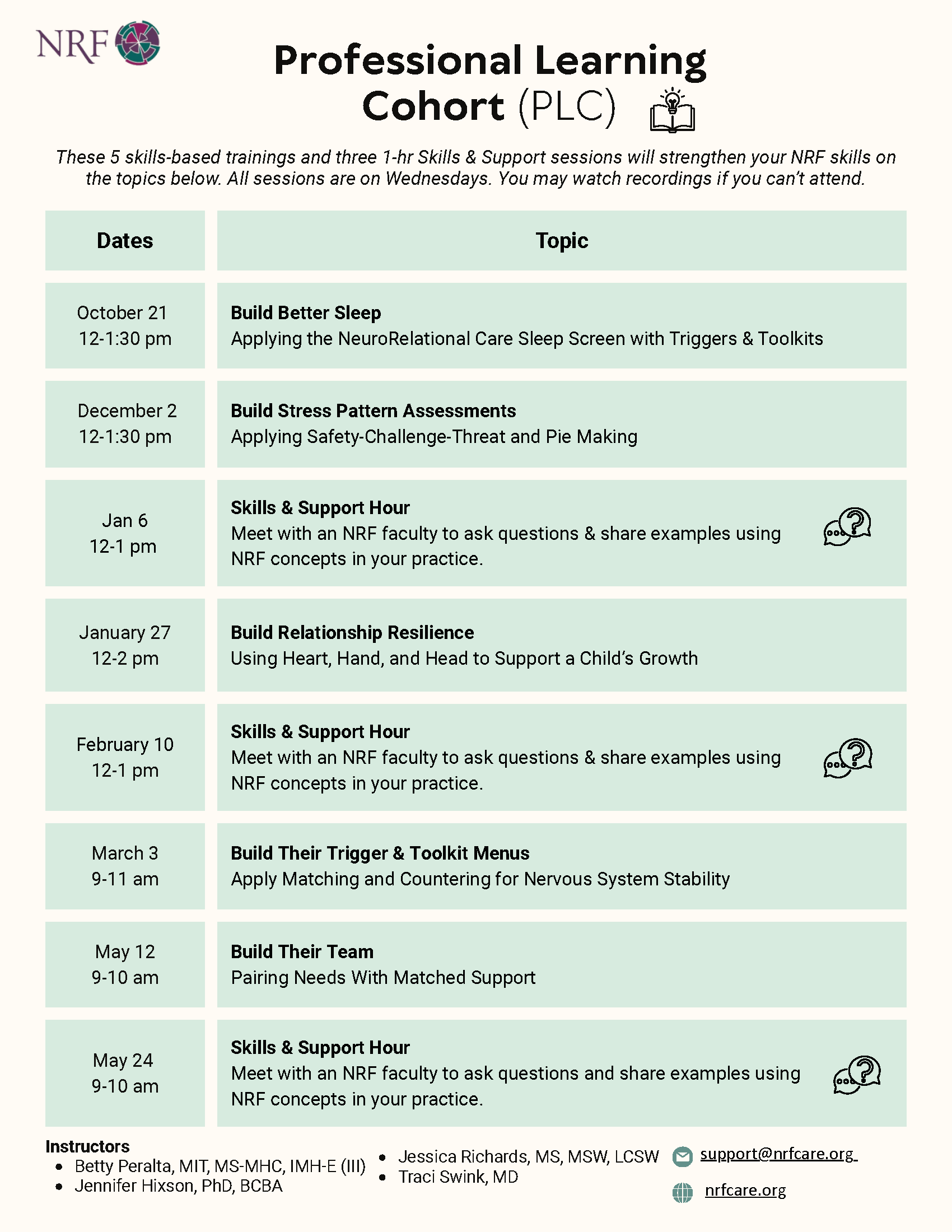
Professional Learning Cohort (PLC) Workshops
🎓Up to 11 Contact Hours: mental health CEs, educator clock hours, hours towards ESIT certification, and/or hours towards Infant Mental Health Endorsement.
These 5 skills-based workshops and three 1-hr Skills & Support sessions will strengthen your NRF skills you learned in NRF Lite. All sessions are on Wednesdays. You may watch recordings if you can’t attend.
- Learn with fellow ESIT providers across Washington state to deepen your NRF skills & receive faculty support.
- 8-11 hours of flexible instruction & support, including:
- Five 1.5 to 2 hr. Skills Workshops: live + recorded sessions on topics like sleep, address stress patterns, trust with parents, etc.
- Three 1-hr Skills & Support Hours to apply NRF skills & ask questions as you learn.
- Earn contact hours towards a Level 1 - NRF Foundations Certificate.
Instructors
Learn more about our team here
- Betty Peralta, MIT, MS-MHC, IMH-E (III)
- Jennifer Hixson, PhD, BCBA
- Jessica Richards, MS, MSW, LCSW
- Traci Swink, MD
Learn more about our team here
Community of Practice (CoP)
If you have completed the NRF 16-unit Foundations Course, or completed PLC Workshops, you are eligible to enroll in a a Community of Practice.
🎓Up to 12 Contact Hours: mental health CEs, educator clock hours, hours towards ESIT certification, and/or 12 hours towards Infant Mental Health Endorsement.
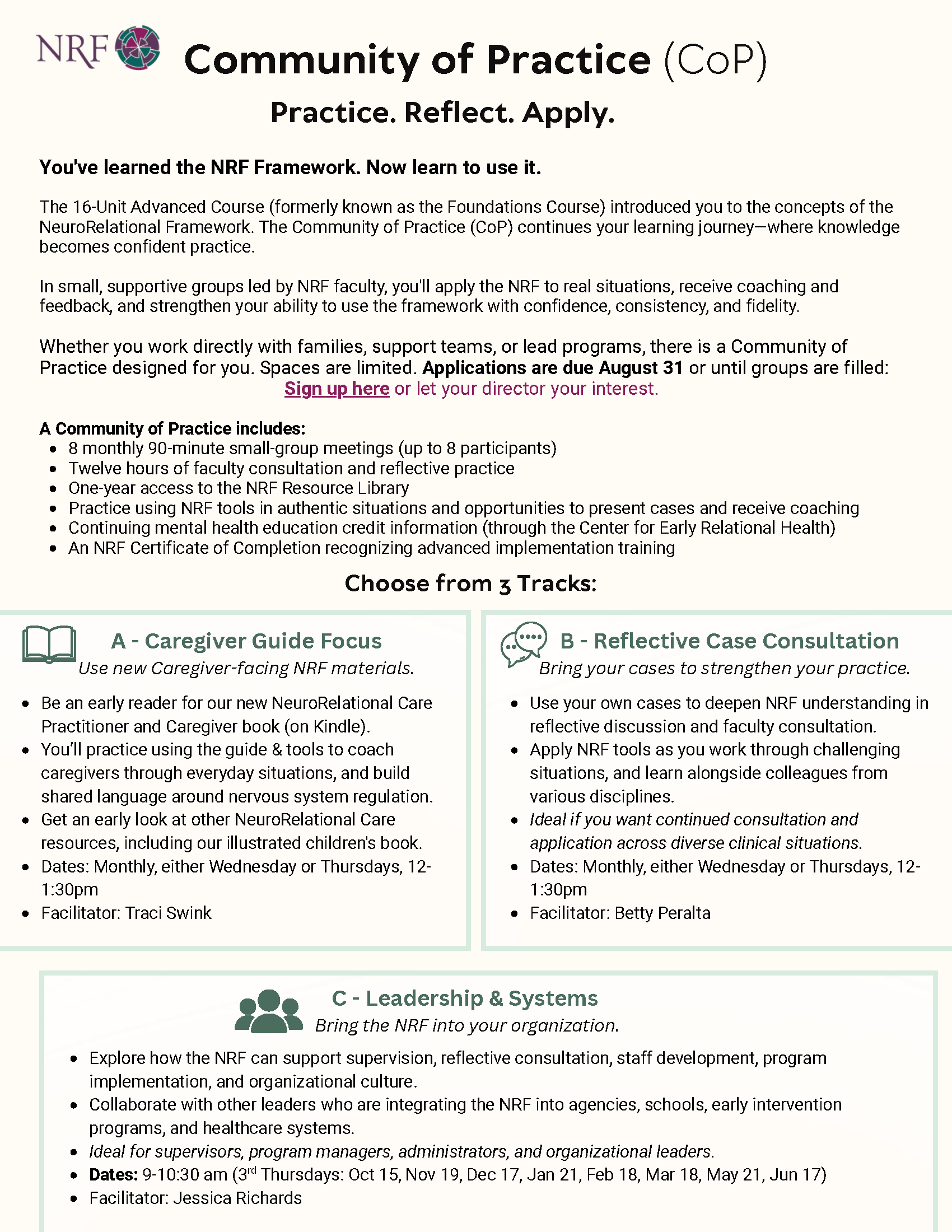
Apply the NRF concepts and skills, supported by NRF faculty in small groups. Community of Practice Includes 12 hours of consultative support and reflective practice through eight monthly 90-minute sessions.
Choose from 3 Tracks:
Note: spaces are limited to up to 8 participants per track
Apply the NRF concepts and skills, supported by NRF faculty in small groups. Community of Practice Includes 12 hours of consultative support and reflective practice through eight monthly 90-minute sessions.
Choose from 3 Tracks:
- General: Your cases are the focus of reflective practice.
- Parent Support: Use our new parent guide to support your families.
-
Leadership: Apply the NRF in leadership/supervisory settings.
Note: spaces are limited to up to 8 participants per track
Click image to expand
Group A - Caregiver Guide Focus
Use new Caregiver-facing NRF materials.
- Be an early reader for our new NeuroRelational Care Practitioner and Caregiver book (on Kindle).
- You’ll practice using the guide & tools to coach caregivers through everyday situations, and build shared language around nervous system regulation.
- Get an early look at other NeuroRelational Care resources, including our illustrated children's book.
Dates: Monthly, either Wednesday or Thursdays, 12-1:30pm
Facilitators: Traci Swink & Connie Lillas
Group B - Reflective Case Consultation
Bring your cases to strengthen your practice.
Dates: Monthly, either Wednesday or Thursdays, 12-1:30pm
Facilitator: Betty Peralta
- Use your own cases to deepen NRF understanding in reflective discussion and faculty consultation.
- Apply NRF tools as you work through challenging situations, and learn alongside colleagues from various disciplines.
- Ideal if you want continued consultation and application across diverse clinical situations.
Dates: Monthly, either Wednesday or Thursdays, 12-1:30pm
Facilitator: Betty Peralta
Group C - Leadership & Systems
Bring the NRF into your organization.
Dates: 9-10:30 am (3rd Thursdays: Oct 15, Nov 19, Dec 17, Jan 21, Feb 18, Mar 18, May 21, Jun 17)
Facilitator: Jessica Richards
- Explore how the NRF can support supervision, reflective consultation, staff development, program implementation, and organizational culture.
- Collaborate with other leaders who are integrating the NRF into agencies, schools, early intervention programs, and healthcare systems.
- Ideal for supervisors, program managers, administrators, and organizational leaders.
Dates: 9-10:30 am (3rd Thursdays: Oct 15, Nov 19, Dec 17, Jan 21, Feb 18, Mar 18, May 21, Jun 17)
Facilitator: Jessica Richards
FAQs
Do I need to attend all 5 Professional Learning Cohort (PLC) workshops and Skills & Support Hours?
If you are unable to attend a session live, you can watch the recording. If you want to earn CEs and get hours towards an NRF certificate, you need to attend all sessions (which includes watching the whole recording) and take accompanying feedback surveys.
Will this training allow me to get CEs?
Yes, you can earn Contact Hours for these courses.
- PLC Workshops: Up to 11 mental health CEs, educator clock hours, hours towards ESIT certification, and/or 11 hours towards Infant Mental Health Endorsement.
- Community of Practice (CoP): Up to 12 mental health CEs, educator clock hours, hours towards ESIT certification, and/or 12 hours towards Infant Mental Health Endorsement.
Is coursework self-paced or cohort-based?
PLC workshops are offered in cohorts, which includes a combination of live Zoom sessions, a discussion board, and self-paced pre-training recordings and coursework. CoPs are cohort based. The power of the
CoPs is that you will be in a live online session to learn from one another, sharing your cases with other practitioners, guided by your NRF faculty member in consultative support and reflective practice in eight monthly 90-minute sessions (12 hours).
CoPs is that you will be in a live online session to learn from one another, sharing your cases with other practitioners, guided by your NRF faculty member in consultative support and reflective practice in eight monthly 90-minute sessions (12 hours).
How much do these courses cost?
This training is paid for by ESIT, so it is offered at no cost to ESIT providers.
NRF Institute is offering dynamic educational training to cross-sectored communities with at-risk infants, children, adults, and families experiencing trauma, neurodiversity, and complex diagnoses based upon the use of the NeuroRelational Framework (NRF).
Join our Mailing list
Thank you!
Copyright © 2026 NRF