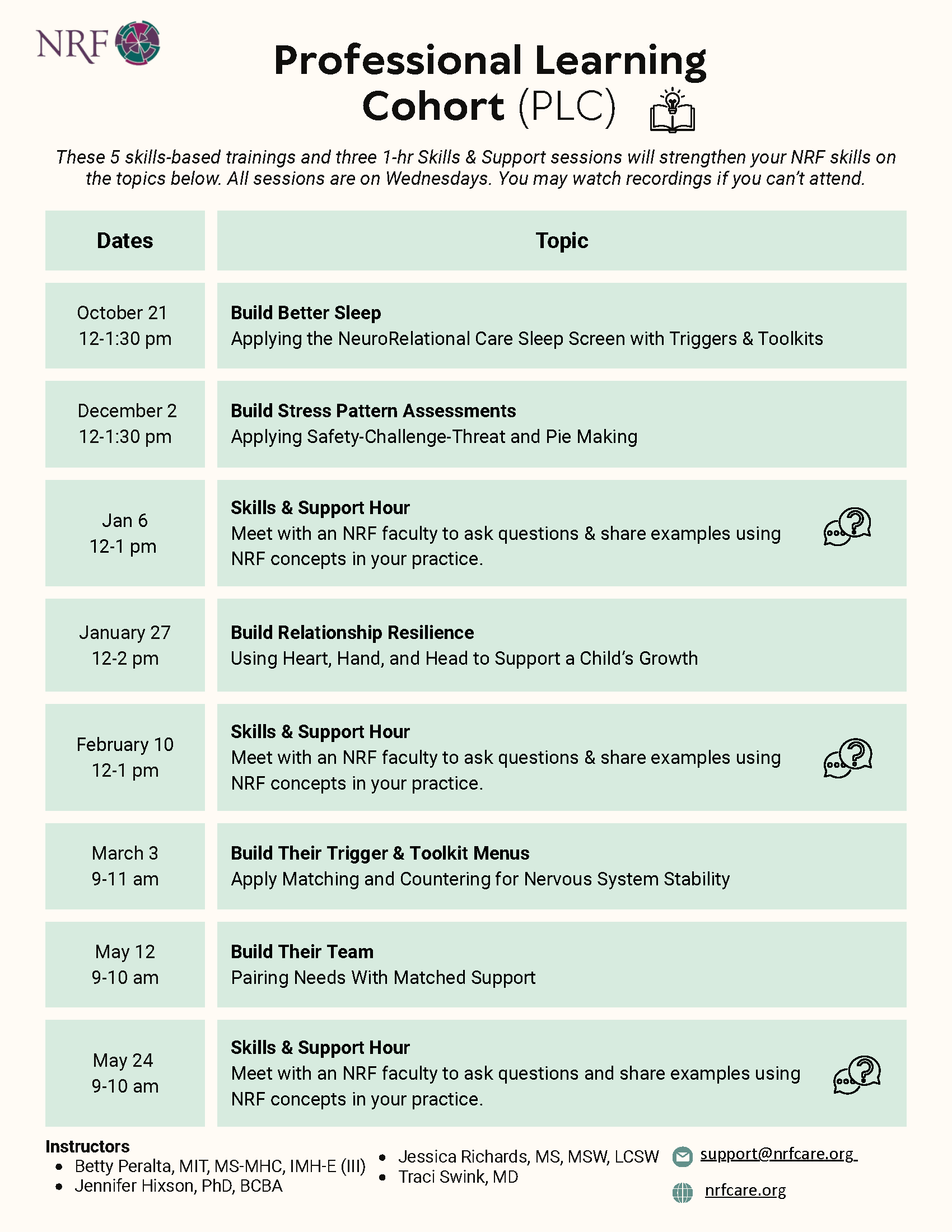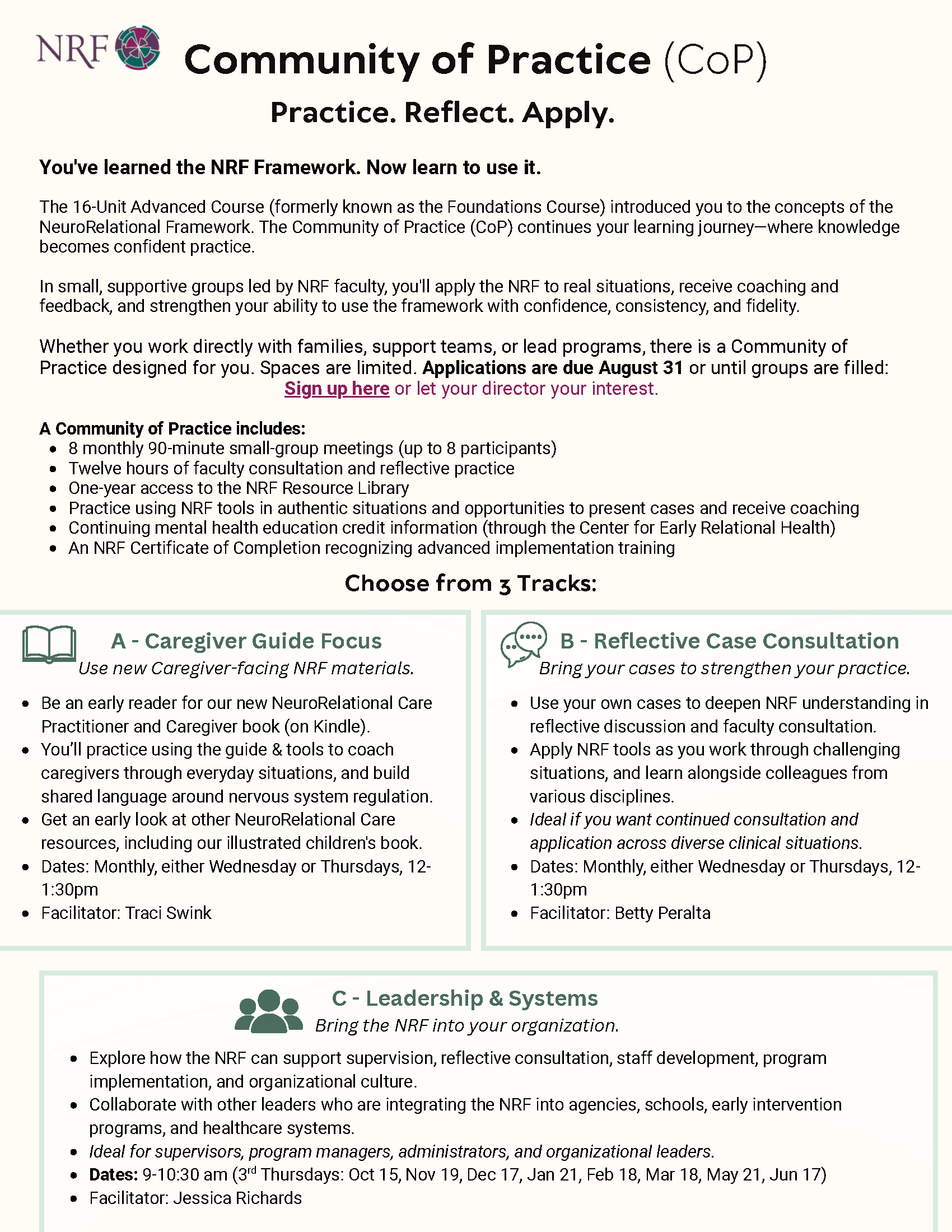
NRF INTRO: VIRTUAL LIVE TRAINING
A Nervous System-Driven Framework to Help Heal Stress in Children & Families
Free for ESIT professionals
When families are navigating the NICU-to-home transition, complex autism, significant medical needs, or trauma, conventional approaches often fall short.You’re supporting families with complex, overlapping needs—work that adds real intensity to an already full caseload.
This 3-hour introductory training offers a new way forward. You’ll be introduced to the NeuroRelational Framework (NRF)—a nervous system, relationship-based approach for the children and families who need it most. Walk away with tools you can use right away, and a clear next step if you want to deepen your learning.
Skills You’ll Walk Away With
- Identify the range of children's nervous system states.
- Distinguish between adaptive stress (growth-promoting) & toxic stress (growth-inhibiting) when observing children and families.
- Identify developmental markers that indicate conditions of relational safety.
- Describe how multiple brain-based systems can influence a child’s behavior.
Course Approach
- A storytelling walkthrough that models the NRF principles in action
- Culturally-sensitive considerations woven throughout
- Customizable model for children and families’ unique needs.
Come ready to reflect on your own nervous system, your clients', and the systems
Questions? Email support@nrfcare.org
What is the NRF?
The NeuroRelational Framework (NRF) is a translational framework, translating brain science into clinical practice. Our passion is to train communities, particularly pregnancy to five-year-olds and their caregivers in trauma-informed and neurobiologically sensitive developmental care.
We support practitioners in furthering a cultural awareness of themselves and their families as cultural beings. To promote sustainability and systems change, we specialize in training and transforming communities.
We support practitioners in furthering a cultural awareness of themselves and their families as cultural beings. To promote sustainability and systems change, we specialize in training and transforming communities.
Testimonials from other ESIT Practitioners
-
"The NRF content directly impacts my work as an early intervention physical therapist."
-
"This training pushed me to think deeper about how I can support parents to find and understand their child's unique preferences (comforting contact, sharing joy, and understanding cues that may not be intuitive to them)."
-
"The information is presented in an understandable way for providers, regardless of experience. I can immediately think of how to incorporate this into my practice."
-
"The content was relatable, and led to real self-reflection."
-
"I enjoyed the group participation activities and opportunity to collaborate with all my colleagues: sharing ideas, experiences, and resources.”
-
“I learned more about the purpose of behavior and how to support regulation.”
-
“I love that we discussed the importance of co-regulating as practitioners and with parents. I appreciated learning about rewards and punishments: so many parents do these things without realizing, and having factual info and resources is very helpful to support conversations with them.”
NRF Institute is offering dynamic educational training to cross-sectored communities with at-risk infants, children, adults, and families experiencing trauma, neurodiversity, and complex diagnoses based upon the use of the NeuroRelational Framework (NRF).
Join our Mailing list
Thank you!
Copyright © 2026 NRF